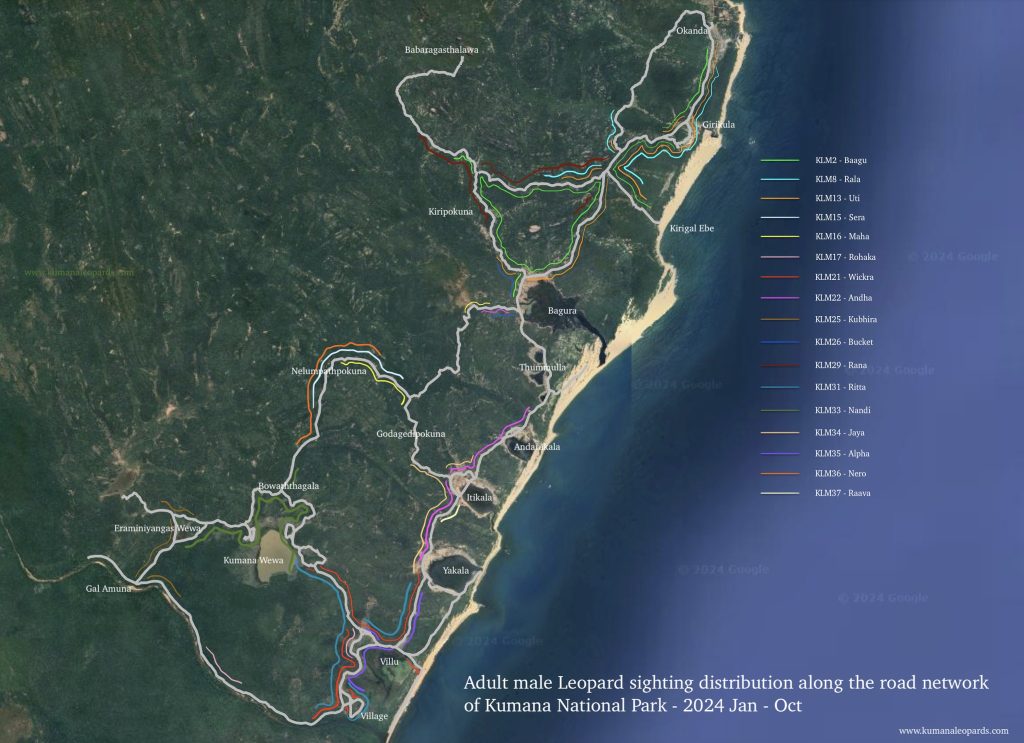
Male leopard distribution in Kumana National Park

This is a visual of male Leopard (adult) distribution along the road network of Kumana for the past 10 months.
If you would like to find certain big boys, this can also be viewed as “Where are my best chances of seeing a particular male leopard given the limited road network?” 
On a more serious note, on what’s visualized here, this is a sturdy indication of how they are territorial, yet how they share a significant portion of the same territory with other males concurrently. Over the years, we were fortunate to observe and document a very few intense confrontations between males, however the majority of the times we understood they tend to avoid each other and utilize the same areas at different times to prevent confrontation. It is believed that Leopards are highly adaptable to situations, and maybe this is a strategic way of adapting to high density leopard habitats to mitigate injury risks.
Reading through this graphic, there are certain noteworthy areas. It’s remarkable how KLM2 Baagu, KLM8 Rala, KLM13 Uti and KLM26 Rana regularly overlap each other’s territories for a long period now, around Okanda wela, Girikula Kuluwana, Kirigal ebe, Diwulpallama, Kiripokuna and Bagura. We’ve seen Rana’s and Baagu’s confrontations a couple of times, yet they still hold onto the same grounds.
In the far southern side, KLM17 Rohaka, KLM21 Wickra, KLM31 Ritta and KLM35 Alpha have been sharing certain areas around Yakala, Villu, Village, Madamethota and Kumana Wewa 1st junct for a considerable period now.
In the southwest, KLM16 Maha, KLM15 Sera and KLM36 Nero shares certain areas around Nelumpathpokuna.
We looked at habitat conditions of these overlapping territories and found that prey and water is abundant year long, and female leopard density is plentiful. Possibly having access to ample resources could be a crucial factor of shared territories among male leopards.
We limited this visual to represent the last 10 months of data to make it more visible and less complex to read. However, the pattern for the extended period is no different based on the data we collected over the last six years – Leopards appear to be more tolerant of shared territories across the park!
As always, it’s worth mentioning the importance of sharing sighting information among us. Without years of shared data, this study wouldn’t have been a possibility. Huge thank you to everyone’s contributions. Please feel free to message us if you would like to discuss/understand our work.